Welcome to the Essential Light Photography Blog By Jim Sabiston


Sunday, April 17, 2011

Intersections

To some degree, we all lead insular lives. We have our daily routine, our family, our circle of friends and, finally, our workmates. A radiating circle with distinct and finite edges that we rarely venture out of. This is generally the norm and makes for a comfortable, secure and relatively predictable life. Most people consider surprises and the unpredictable a bad thing. Yet, what we think of as security is at best pleasant illusion.

This is one of the primary traits where my wife Nancy and I were polar opposites when we first met. She was a planner. Invite her to an event and the day planner came out of her purse to verify availability and to record the commitment. I, on the other hand, knew that if the event was beyond the next 24 hour window, I was likely to be free. When Nancy planned a trip, on Tuesday she would be scheduled for this, on Thursday for that. I introduced her to the pleasures of serendipity and chance when I planned a return trip to the Scottish Highlands for our tenth wedding anniversary and second honeymoon, the first being spent in Edinburgh. My planning consisted entirely of purchasing round trip airfare to and from Glasgow and a rental car to be waiting at the Glasgow airport. In between the flights was a two week window wide open to possibilities. The general idea was simply to drive north and west towards the coast and see what might happen. We didn't even know where we were to stay the first night.

Each day was a surprise. We had no idea where we might be sleeping, where we were going or what we would eat. Nancy still describes that trip as the best two weeks of her life. There is an old truism that in order to truly experience the highs of life, one must also experience the lows. This trip illustrated that concept in a very real way - the most dramatic being near the end of our stay. We were driving south as we started to close the circle on our return from the Isle of Skye, where we had discovered a delightful bed and breakfast overlooking the Portree harbor. One of the surprises was the lack of civilization in the stretch south from the Skye Bridge. We had taken the ferry to Skye from Mallaig and had not been in this particular part of the Highlands previously. The countryside was spectacular in its rugged, Highland beauty, but by the time we arrived back in Fort William late in the day, there were no vacancies to be found. We continued south for hours, finally into the night as we approached Oban. At this point, we had already resolved that we were likely to spend the night sleeping in the car and were looking for a place to have dinner. In Oban, quite by chance, we discovered hidden on an obscure single track a bed and breakfast on a hill overlooking the old city. They had a single vacancy.

It turned out that the proprietor was a retired Queens chef who owned and ran this small but exquisite gem. The room had a window view of the city below and, much to our delight, served dinner as well as breakfast, but only to his guests. Nancy and I then proceeded to enjoy two of the finest meals of our lives.

If we had planned our trip in advance in the normal fashion, we would of had a very different experience. When planning trips, people tend towards the known. There is certainly sound logic to this, of course - surprises are not always good. The price of this security is a certain isolation from the potential of getting a real flavor of the people and places you visit. A Marriot is a Marriot is a Marriot, regardless of the state or country it happens to be in. The very intent of these hotels is to provide a consistent, predictable, known environment for their guests. In the process, they remove all but the most highly distilled local flavor. This is why Nancy and I never stay at a major chain hotel if there are other options. The experiences we want are to be had in the local bed and breakfast, and the small diner or pub where the locals congregate - like that wonderful off-the-track pub near Loch Fyne just north of Argyle Forest that served a wondrous steak pie and local beer. We spent that night in Minard Castle, the only guests in the newly renovated castle that wasn't yet in the tourist listings.

This has not been a one way relationship, however. Nancy's gift to me is her natural gregariousness. She has a way about her that makes her incredibly approachable and outgoing. I can't count the number of times that I've found her somewhere catching up with an old friend only to learn that she had known the person for all of 10 minutes. It amazes me and I can't help but be in awe of it in some ways. The good news is that I have picked up on some of this and am far more open to approaching total strangers than before we met. Obviously, these two traits make for a happy combination when traveling, opening doors to people and experiences that most will miss.

I have found that both can also be applied to photography, specifically photography of strangers in public places. I have great respect for peoples privacy and act accordingly. Unfortunately, this otherwise virtuous trait can be a negative when working on images such as those in my Street Scenes series. Most are candid shots of people and places and these require a strong dose of unobtrusive practices. The idea is to get the image without the subject realizing I am even there in order to capture unaffected human behavior. I want the natural moment to shine through.

(click on image to enlarge)
There is another type of image, however, and these require at least the knowledge on the part of the subject that I am there, if not actual, active participation in the process on their part. An actual interaction must take place between the photographer and the subject. Here is where we depart from the known and comfortable. The photographer must be willing to reach out to a total stranger with an invitation to join in the creative process. This is not the sort of thing that intrudes into the daily routine very often - but serendipity and chance open the door to wonderful creative opportunity if we are willing to step outside of our own shell.

By the very nature of the required interaction, these images tend to be far more intimate, as the relationship between the photographer and the subject is unavoidably more close, both locked in a subtle dance. For the process to even begin, I must speak to my potential subject and broach the topic of my intent. Photography of this nature is still quite new to me, but has so far proven to be a pleasant experience. I find that my subjects tend to be fascinated by the process and are generally perfectly willing, even eager, to participate. the result is what is proving to be the beginning of a series of images with enormous potential. I will provide one example, an interaction which took place quite unexpectedly on the commute home recently.

I had just settled in for the train ride home when this guy sits in the seat facing me. I've never seen him before. Tattooed, a little dusty, definitely rough around the edges. Stocky build, but not real big - but real solid. Not a bit of fancy or soft about him. Big strong, workingman arms. These arms radiated life, emanating strength even in their relaxed repose. These were the arms of a man who relied on strength and muscle to get through his day. I had to take a photograph. I introduced myself and explained my interest. He was a really nice guy. He assumed the relaxed pose that had initially caught my attention and I quickly set up for the shot. He was completely natural - no tenseness in him at all. I exposed three frames - one was a keeper. I gave him a card and invited him to my show opening a couple of days later. Hopefully I will see him again so he can see the result of our meeting.

(click on image to enlarge)
By exercising the willingness to expose myself and an artistic impulse to a stranger, art was created in a space where the otherwise natural social impulse is to maintain the protective shell of personal space. So much is lost in this self imposed closure. I can't help but think that humanity as a whole suffers from this internal and artificial isolation when the chance meeting of strangers is not fully acted upon. The result is that we remain strangers in a crowded room.

Tuesday, March 29, 2011

New York City Graphics

One of the things that continues to really fascinate me about photography is how it requires me to constantly re-evaluate how I perceive the world around me.

The play of light is everywhere and ever changing from moment to moment. Most of us move through our days entirely unaware of this often delicate, sometimes (literally) glaringly brash symphony taking place around us. Light does not often call attention to itself the way sound and sensation do. It takes intent and awareness on our part to look beyond the details of our normal realm of perception.

So it has been with the new series of photographic images I started experimenting with for my New York City Graphic collection. As I mentioned in the previous blog post, I began with a new understanding of Arthur Stiegletz's approach of evaluating the overall light and shadow effects of the New York buildings around him. The architectural revolution that led to the creation of the modern high-rise building had only just begun at the end of the period where Stiegletz was actively photographing these scenes. As a result, we can see his images of such creations as the newly erected GE Buildings (both of them) standing in clear air, well above the surrounding, smaller structures of the day. Once distinct, solitary towers, these iconic structures are now lost in a crowd of modern glass, concrete and steel.

This opens up opportunities and challenges for the modern photographer that Stiegletz never had. I realized this immediately once I changed the way I looked at these massive structures which I walk among everyday going to and from work. When we see something so frequently, we become desensitized to the presence and impact of these objects. This applies even to massive skyscrapers. Most New Yorkers only perceive the first floor/sidewalk level of their surroundings. One of the surest signs of a tourist in the city is the simple fact that the person has stopped in the middle of a busy sidewalk and is actually looking UP! This behavior is actually considered a bit gauche by native New York City residents and even 'bad form'. Yet most of the truly interesting architecture exists well above street level.

It isn't the architectural detail that is pulling at me right now, however. The change in perspective has opened a new world of visual acuity. Lately, I seem to have just enough attention at street level to avoid tripping over pedestrians or getting flattened by a bus, but sometimes just barely. My attention is now constantly among the high glass towers as I seek out the potential for graphic patterns on a truly massive scale, literally hundreds of feet up. I have made several excursions into New York City with this specific purpose in mind, walking miles and miles of mid-town sidewalks seeking out sight lines and glass panels. There is the promise of potential around every corner. The results have been truly exciting, with dozens of images the result. Even still, I have barely scratched the surface of the available potential here.

Here are several examples of some of the photographs that are a direct result of this exercise. The first image, 'Cubism', is an unabashed exercise in pure graphics. There are none of the typical architectural details that would normally pull in a viewer's attention. Instead, what we have is a very structured visual of clearly defined light and shadow, all expressed in sharp, straight lines. The overall feel is one of firm and massive, if slightly confused, stability as the repeating pattern of stacked cubes seems to find no real pattern or rhythm.

(click on image to enlarge)

Next is 'The Monoliths'. As with the previous photograph, this image was shot in hard midday light to emphasize the sharp, hard lines delineating light and shadow. A massive stability also reigns in this photograph, but the character is driven by the unavoidable clarity of the repeating vertical lines marching towards the horizon, accentuated by the deep, unsettling shadows.

(click on image to enlarge)

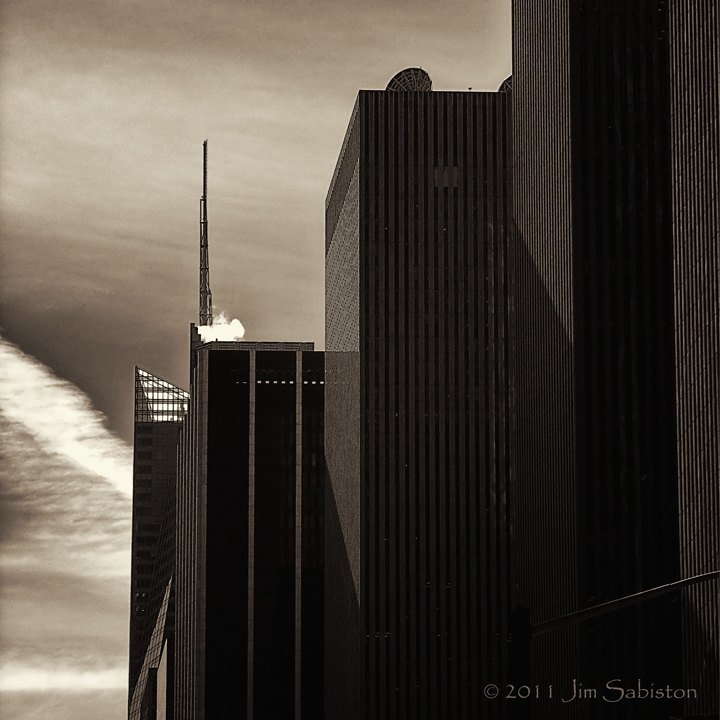
Our last example, as yet untitled, takes a slightly different turn. The modern, steel and glass structures are ideal subjects for this exercise due to their inherently clean, direct and often unbroken lines. Older structures, while almost certainly more attractive in their architectural detailing, don't quite work as well in this exercise as the very details that make them attractive tend to break up the clean lines I am looking for. That said, I found the contrast between the two styles intriguing in this image. In the foreground is 101 Park, a very distinctive angular slab of a structure. Behind it, mostly hidden, is the spire of one of New York City's most recognizable classic structures, the Chrysler Building. Even with the modern building's presence mostly obscuring the older classic, there is no hiding the distinctive identity, or the uniqueness, of the latter.

(click on image to enlarge)

The project is ongoing and I will likely continue it indefinitely as I continue to search out new sight lines and the massive glass panels rising high into the sky.

Tuesday, February 22, 2011

On Learning, Stiegletz and Photography as Art

I am frequently asked about my training as a photographer. Where did I go to school? Under whom did I study? Most are surprised to learn that I am completely self-taught. I have never taken a photography course, or for that matter, even an art course – not counting that required one we all took in 8th Grade.

The fact is, there are many resources available to the individual who has an intense desire to learn and I take full advantage of them. I started with books, then moved on to video tutorials on the web and the many quality blogs maintained by some very good photographers who are willing to share their hard earned knowledge. I pay this generosity forward by freely sharing what I’ve learned with anyone who has a sincere interest. I am reminded of a very polite young man I met recently at the C2 Gallery reception of the Annual Long Island Artist Invitational who had several questions about my compositional methods and processing techniques. After a brief discussion, he flattered me with the compliment that he learned more from me in ten minutes than anyone else he had ever discussed photography with. But, as the saying goes, I stand on the shoulders of giants.

No artist can proceed completely from a blank page. We are at some point inspired by another’s work that moves us deeply enough to want to try our hand at it. As I’ve mentioned in prior posts, was initially moved by the works of Maxfield Parrish and Andrew Wyeth. I still keep Wyeth’s book on my desk for frequent reference. For photographic inspiration, I peruse the various and numerous publications for ideas and techniques, but I’ve taken a different route in searching for the real core of the photographic medium. I’ve gone back to the beginning, studying the works of those who put photography on the map as an art form.

In America, it is impossible to do this without running full into the body of work assembled by Arthur Stiegletz. More than any other individual, Arthur Stiegletz moved photography away from its representational roots towards the more ethereal world as an artistic medium. I did not immediately grasp how he did this. My initial studies of his work did not give me an overt sense of why they should be considered art, although the images were often stunning. As my education has progressed, this has become abundantly clear, however. Part of the matter is that my initial considerations of Stiegetz’ photography made some erroneous assumptions:

What I initially thought were limitations of the early technology turned out to be the results of intentional choices on the part of Mr. Stiegletz to achieve an artistic end. This was driven home with unwavering certainty when I had the rare pleasure of seeing 39 of Stiegletz’ actual prints at a recent showing in New York City. Along with the prints, the curators also provided various commentaries on Stiegletz’ methods. The real center, however, was the inclusion of several of his original un-enlarged prints, run right from the original plates. What became immediately apparent is that the impressionistic ‘softness’ of the final prints was not at all a limitation of the medium, but a desired effect. The images on the original plates were razor sharp! This observation was timely, as I am currently reading the ‘The Key Set’, the massive publication of all Stiegletz’ 1,682 favored prints, as assembled after his death by his wife, Georgia O’Keefe. Here we learn of the use by Stiegletz, not so much of photographic detail, but rather broader considerations of light and form within the frame. Stiegletz was sharply aware of the current movements within the arts and how they might be applied to photography. Much of this approach is reflected in his New York city images.

So where does this lead me, the student? The primary effect was to cause me to reconsider how I examine and consider the photographic potential of my subjects. Photography, by its very nature, tends towards literal representation – but we must find a way past this if we are to produce photographic art. What I have learned is to see beyond the superficial detailed representation to the broader forms and relationship of light and dark within those forms. The direct result is a recent series of photographs taken in midtown Manhattan which have opened an entirely new visual world for me. The realization of the power within this approach hit upon me quite suddenly and unexpectedly while doing a series of shots of one of my favorite skyscrapers – the original GE Building on the corner of 51st and Lexington.

I had long wanted to get a properly atmospheric image of this amazing architectural masterpiece and this particular day had just the right conditions: mostly clear with thin passing clouds, and a low, midwinter afternoon sun combining for dramatic shadows and strong contrast. Playing to the stark difference between the deep, broad shadows and contrasting sunlight, I wanted to bring out the uniquely modern gothic character of the structure. The resulting mood is carried by the massive, shadowed presence in the frames, but the definition is carried by the highly contrasting lighted details.

(Click on image to enlarge)
Pleased with the result, I wondered if the effect could be carried even farther with modern, glass-sided buildings with their virtual elimination of ornamentation. I walked through midtown looking for potential subjects. The first was this study of the Citicorp building, viewed from across the street from the Seagrams Building on Park Avenue. The result is quite dramatic! The resulting photograph takes on a poster-like graphic directness.

(Click on image to enlarge)
I continued the exercise as I walked through mid-town and finally took the concept another step farther by searching out more interesting shapes, particularly ones with a strong geometric presence. The result was this shot:

(Click on image to enlarge)
Almost cubist in its impact, the pure geometrical shapes highlighted by the extreme light and dark details drive this image to an unexpected place – visually more graphic than representational in effect,. This is especially ironic in that both of the latter two images have very minimal processing – just fine-tuned contrast and sharpness. As photographs, they ARE representational, but the careful composition and use of light changes that aspect utterly for the viewer.

I like the results of this experiment enough that I may start a new dedicated series.

Sunday, January 30, 2011

Just passing through...

Man alive, where did the time go!?! It seems the the Holiday Season hit like a frieght train and left us swirling and bouncing in its passing wake. So much to do packed into so little time. I figured I better get a post up before the whole month of January blew by. Looks like I will just make it.

Aside from the mad rush of the Holidays, we get mixed in the additional logistics of my son Paull's graduation from college, picking up his sister to bring her home, setting up the Holiday display at the BJ Spoke Gallery, etc., etc. As the end of January sneaks up on me, we've had the reception at the C2 Gallery in Patchogue, as I was awarded one of the eleven artist slots for the Annual Artist Invitational. It was one of the best show receptions I've had the pleasure of attending. Some serious talent was present and on display. Planning is well under way for the grand opening of the new, expanded Gallery in March. I will be one of three artists, all photographers, whose work will be presented. It should be an interesting presentation of the various possibilities within the photographic medium. Meanwhile, today we hung eighteen prints in the new gallery space in the Bay Shore/Brightwaters public Library. People were lining up to look over the work even as we were hanging it. The reception has already been a good one!

One of January's highlights for me was the rare opportunity to see original prints of Alfred Stiegletz's photography. Thirty-nine original prints of his work centering on the city of New York were on display at the South Street Seaport Museum. I will post a more detailed report later, but it was an inspiring and educational day. I have been studying Stiegletz's work for some time now, and to see the original work itself was a revelation. My favorite gift was from my ever encouraging wife, Nancy, who bought me a copy of 'The Key Set', the massive tome of Stiegletz's work. This will keep me busy for a long time to come, as the depth of the research is outstanding.

My research into Stiegletz's techniques have been having an influence on my work for many months now. He was one of the first and foremost proponents of photography as an art form and not a mere recording medium. This shows deeply in his work. I have been trying to sort out how to capture some of the feel of his work, as the technology is so much different today - as should be expected of course. This relates in large part to my earlier post regarding the 'impressionistic' quality inherent in images when the resolution is reduced. Of course, the process of acheiving an properly artistic image is far more complex than just reducing the resolution of the image. That is just one part of a many layered process to acheive what the photographer has in mind. I only recently acheived something of what I was trying for in this learning process.

The camera used was my trusty and heavily used Canon G9, set to RAW image capture. The moment, a snowy morning walking to work in New York City. The place, Herald Square. As usual, I was scanning for interesting light, form and contrast as I walked to work. I had taken a few shots, testing the light, when I noticed it, the line of small round bistro style tables so common on Broadway now. A row had been pushed aside to allow pedestrians a clear walking path and the light snow had settled on their smooth, round tops, making a natural broken line pulling your eye towards the backdrop of the Square, and farther along past the iron fencing and arched gate, Broadway fading in the distance. The final element needed were the pedestrians, so I waited a bit watching and prepared for the right moment.
(click on image to enlarge)
Here was the modern vision of Stiegletz's New York as seen in his early work, just at the turn end of the nineteenth century and the beginning of the twentieth. Taken at street level, capturing in the every day moments of the city and in doing so, capturing something of the life and spirit of the great city.

Sunday, December 12, 2010

What do you see?

What do you see? Seems a simple question at first glance, doesn't it?
As a photographer, this is obviously a question present in my mind almost constantly. It happened to come to the fore recently when someone was looking at a photograph I had just taken of the Great South Bay. After gazing at the image for a few moments, they wanted to know what the location of the subject was. I responded by describing where the photograph was taken from and the specific area covered within the frame. But, being me, the exchange prompted a new train of thought.

Was this persons perception limited to the physical reality of the photograph? Could they only see the wonderful color of the reflected light off the breeze kissed water, the strip of land in the distance? I will never know in this particular instance, but it is all but certain that this is the case for some people. All they see is the immediate reality before them. I suppose in some ways this is a good thing as it insures, at least to some degree, that they are engaged in the moment.

The photograph can still work on this level, but if it doesn't trigger more in the mind of the viewer it probably isn't working as the photographer intended. Photography suffers a bit on this front due to the very nature of the medium. The camera, at it's most fundamental level, is a recording device. It allows the user to record some event, place or thing in the present moment for future reference. All other artistic mediums are used in the opposite direction. The artist takes an unformed medium - paint, clay, stone, etc. - that has no inherent representational reality and manipulates it to communicate a message. Photography starts with a representational reality, and must be manipulated to convey a message. For the photographer, this is where the question of 'what do you see?' takes flight.

When I saw this particular sunrise, with it's wonderful and unusual soft, brassy light reflected off the silky smooth, quiet water of the Bay, my initial reaction was much like anyone else, frozen to momentary immobility by the serene beauty of the scene. Having my Canon 5D MKII under my arm, the next thoughts were strictly technical, within seconds the camera was up and I rattled through the process of selecting aperture, shutter speed, focal point, etc. and started shooting. Somewhere in this transient moment of seconds is where we separate the artist from the 'taker of pictures'.

(click on image to enlarge)

Most people in that moment see the water, the color of the light, the island in the far distance. The observant will also notice the cloud formations and the really observant (or sailor!) will notice the reflections and patterns of the breeze touching the surface of the water. The photographer sees all these things and more. The aspect that makes the difference - What do you SEE? - lies within the power of metaphor, the potential for broader interpretation within the scene.

One of the aspects of a truly effective image is its ability to trigger the imagination. The body of water and islands in this photograph are intimately familiar to me, having sailed, kayaked and walked these places since my youth. Even still, when I look at this image, the composition and various elements of color and hints of form evoke the wanderlust within me. Recognizable features and details fade away in the distance and my imagination brings forth thoughts of far away places and exotic cultures. The ever curious explorer in me wants to go there, to discover new wonders and experiences that may lie in the mysterious islands just visible on that far, golden horizon.

The camera becomes so much more than a recording device, it has the potential to become a key to other worlds and places, even other times. The photograph opens a door to the place of dreams and fantastic imaginings. This is what I see when I look through the lens. What do you see?

Sunday, November 14, 2010

New Perceptions

I was watching the news a few weeks back and had a minor revelation. The news show was reporting on an extreme local weather event, a tornado, that went through the local neighborhood of Forest Hills. In what has become an increasingly common occurrence in the modern electronic age, the regular news report was augmented by a a series of images taken with a cell phone camera.

This is nothing new or even unusual anymore, as cell phones are now ubiquitous - even Grandma has one - and they all seem to have cameras these days. I usually lament the abysmal quality of the images taken with these little 'chip based' cameras, and rightfully so. The images suffer from heavy jpeg compression, and terrible lenses. I've played with the 5 megapixel version in my Samsung Omnia and had some success as long as my expectations weren't too high and I remained fully aware of the limitations of the little thing. On the other hand, as I always have the cell phone with me, I always have a camera too, so there are some advantages.

This opinion just went through a fundamental change.

As I watched the news report and the terrible quality cell phone images flashed by, I noticed something. The images were of terrible quality. The details were badly blurred by the jpeg compression algorithms and suffered mightily. One image in particular jumped out at me, however. It was no better than the rest from the technical standpoint, but some quality in the light and detail made something else evident - it was beautifully impressionistic. The scene didn't matter in this case, but the quality of the detail that was retained reminded me very strongly of the paintings of the early Impressionist painters. Wonder of wonders!

The photo in question was on the screen for about 10 or 15 seconds, tops, but that was enough for me to get the idea that the little crappy camera may offer some potential I had not considered before. The creative urge had been ignited!

The normal trend in processing is to go for the highest possible levels of detail and sharpness. Painters, of course, know better. The next time you have the opportunity to see a realistic painting up close, get your nose right up in it and see what the artist has done. What you will see is that the carefully applied pigments and strokes cease to resemble anything at all as you get in close. It isn't until you back away that your brain starts to assemble those strokes and colors into an image. The talented artist knows just how to fool your eye. Photography does the opposite, using the light reflected off the actual image to record the actual detail as seen, within the constraints of the current technology, of course.

In the early years of photography, there were limits to the level of resolution obtainable and the result is that those images incorporate a kind of impressionistic quality, although it probably was't intentional, just a by-product of the early technology. It is this latter characteristic that has fascinated me for a long time. I have a great deal of time invested in trying to capture something of this quality in certain of my images. A good example of a successful photograph in this regard is 'Harbor House'. It is a bit ironic in that the original Image is captured with high resolution equipment and I then work to remove much of the inherent detail with the goal of conveying a certain idea or 'sense of place' rather than the overly detailed specifics of the scene.

I am in the early stages of sorting the possibilities here, but I have made some progress with the technique. Here are two examples, one dug up from a trial shot for a future project idea and another just a quick snap of a scene that caught my eye one morning last spring. First is a test shot of the newly renovated and expanded Jamaica Station in Jamaica, NY. I really like the combination of strong diagonals combined with the old and new elements of the scene, but a straight shot would not convey the sense of the place I am looking for. The bad quality cell phone image provided a surprise in that I saw the seed of what I really wanted in it. A black and white conversion and some subtle applications of Photoshop filters get me really close to what I wanted.

(click on image to enlarge)

This is not the final image, but it is a good precursor of what the final image will look like. Next, is the little snapshot of some orchids in a flower vendor's stand on 37th Street in Manhattan. The color in the original jpeg was too garish and aside from a Facebook post, I figured it was't worth much. Just the same, it had a quality that held my interest enough that I saved it in my archives for future reference. I thought it would be an ideal subject for this new process and it seems to have been a good choice.

(Click on image to enlarge)

I am still experimenting and refining the filter processing to achieve just the right combination of retained detail and that subtle impressionistic quality. It will be interesting to see where else this concept takes me.

Tuesday, September 28, 2010

The Time Traveler

One of the aspects of photography that few consider is the dimension of time. I'm not speaking to the fairly straightforward matter of shutter speed vs aperture here. As specialized technologies can extend human sight to the extremes of the electromagnetic spectrum – think x-ray and infrared imaging as common examples - photography has the ability to extend our vision to include the dimension of time.

Most photographic images are, in one form or another, created by recording a specific and finite moment, typically measured within some very small fraction of a second. This is desirable, as this gives a very clear, detailed image for whatever purpose the photographer has in mind, be it posterity or art. We are 'freezing a moment in time', as it is frequently described. Most photographers never depart from this standard approach. Time, as an element in the image, is usually no more involved than a quick calculation in concert with the aperture opening to compose the subject in a particular way.

There is a whole other world out there, however, existing in the intersection of light and motion. It is possible to step back a bit and actually reconsider time as an integral part of the moving world. It is also possible, with a bit of thought and creativity, to include time as an integral part of the photograph. The results can be quite stunning and bring an entirely new perspective to the viewer.

Most of the time, movement is the enemy of the photographer. Movement blurs details and can ruin an otherwise good photograph. Thus we have faster lenses, more sensitive sensors and film combined with the requisite blazing fast shutter speeds. My Canon 5D MkII is capable of shutter speeds as fast as 1/8000 of a second. It is difficult to even comprehend how short a span of time that is. In some circumstances, such as sports and action shots, or trying to freeze the motion of a hummingbird wing, these capabilities are not only desirable, but necessary. To introduce the element of time into an image, we need to go in the other direction, however. A sports photographer may want a bit of blurring in order to convey movement and action, so will use a slightly slower shutter speed to do so. A nature photographer commonly uses a slightly slower shutter speed to the same end. This is most commonly seen in water shots, where the movement of a stream or waterfall is intentionally allowed to blur slightly. This has the effect of both softening the look of the water and brings an element of life to the scene by highlighting the movement of the water in the stream or waterfall. The results can be quite beautiful. Still, in these shots we are typically using small fractions of a second. Most of my images of this sort use a shutter speed in the area of ¼ second or much less. Time is used sparingly and discreetly.

(click image to enlarge)
It is possible to use much larger chunks of time. When this is done, the resulting images change utterly and with them our view of our world. We suddenly begin to see things as part of a continuum rather than a single, unique instant. One of my more popular photographs is of an abandoned and deteriorating dock on the Wicomico River in Maryland. It took over a year and several attempts to get this shot. The dock had fascinated me and I longed to capture the subtle character of it that intrigued me. Dozens of shots were taken and discarded. They just lacked that certain something I saw there, but couldn't quite translate to the image. Finally, one morning I was out before dawn (again!) to try and shoot a bald eagle known to spend the night in a local tree and I found what I was looking for. The morning was windy with intermittent rain, what most people would describe as 'miserable', and accurately so I suppose! The eagle shot did not work out, but walking back along the river I passed the old dock again and was struck by the conditions. For how many years had this old dock weathered such storms, and yet here it still remained? It was showing the years and mileage for sure, but still standing.

I quickly rearranged my entire concept of of what I had been trying to do with this subject. I set the camera up on its tripod, being extra careful to ensure it was planted solidly on the grassy shoreline of the river. I then installed a polarizer and four stops worth of neutral density filters, cutting down the light coming into the camera lens by a total of six stops. It was still overcast and dark. If the sun had risen it was impossible to tell, but I needed the low light in combination with the neutral density filters for my intended shot. Once set up, I attached the remote shutter release – it was imperative that the camera remain absolutely motionless. The shutter speed was set to 25 seconds.

I clicked the shutter and waited what seemed an hour while the seconds ticked away. I then took some bracketing shots at slightly different settings as insurance, but the 25 second exposure was the best in these conditions. I stayed out and took a few more shots, but none really panned out after the dock shoot, as the rain became heavy and the lens was getting too wet. I packed up and walked back to the bed & breakfast where a hot cup of coffee and my ever patient wife were waiting. I eagerly loaded the files into the computer and, finally, there it was, the image I had wanted all along.

(click on image to enlarge)
The long exposure blurs the choppy, windblown waves into a smooth gradient. The rain disappears into a smooth gray mist. The far shoreline a hint of another place. But the dock stands fixed and sharp, as the elements pass around and over it, the dock seemingly permanent and immutable by comparison. But we know the opposite to be true. The dock is already clearly past its prime and the slow, steady wear of the elements will continue to take its toll. If we could extend the exposure long enough, over many decades, we would see that it is the old dock that is the ephemeral element here. The river and wind will remain as elements long after the dock has gradually faded away.

Everything is in motion relative to everything around it. If there exists any constant in the universe, this seems to be it. With a little thought, creativity and patience, the camera can allow a small glimpse into this rarely seen or considered world.